North York Long-Term Disability Lawyer
When illness or injury prevents you from working, a North York long-term disability lawyer can help you recover the benefits you’re entitled to. Many people face denied claims or long delays from insurance providers when they need support the most. At Auger Hollingsworth Accident & Injury Lawyers, our experienced North York personal injury lawyers represent individuals who have been denied long-term disability benefits and need strong legal advocacy to protect their rights.
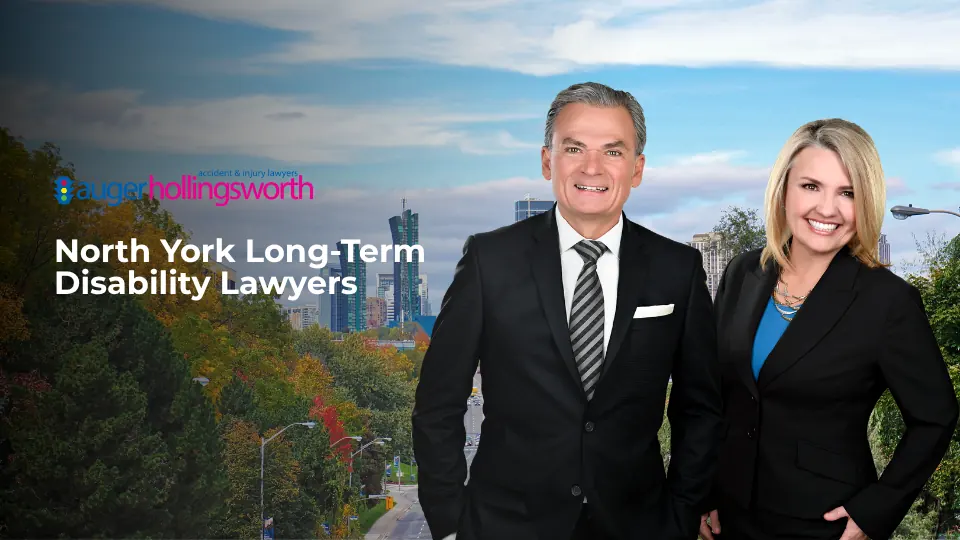
Experienced Disability Lawyer in North York
Our firm offers professional legal services for people with disabilities who are struggling to access their disability insurance benefits. We handle all aspects of long-term disability claims, including negotiations with disability insurers, appeals after denial letters, and litigation when necessary. Our experienced disability lawyers understand the challenges of living with a medical condition, physical or mental, and how it can affect your income and stability. We work to secure fair compensation and income replacement benefits for every client.




What Qualifies for Long-Term Disability in Ontario
To qualify for long-term disability benefits in Ontario, you must demonstrate that a medical condition prevents you from performing the essential duties of your occupation. Most long-term disability policies define this as being unable to work in your “own occupation” for the first two years of disability, and after that, being unable to work in “any occupation” for which you are reasonably suited by education, training, or experience. Insurers require substantial medical and functional proof to support your claim.
Eligibility for long-term disability claims generally depends on:
- Comprehensive Medical Evidence – You must provide detailed documentation from physicians, specialists, or mental health professionals confirming your diagnosis, symptoms, and ongoing treatment. This includes test results, clinical assessments, and medical reports that support your inability to work.
- Demonstrated Functional Impairment – You need to show how your condition, whether chronic pain, mental illness, or physical injury, limits your capacity to carry out regular work tasks. This may include reduced concentration, mobility issues, fatigue, or cognitive limitations.
- Policy Interpretation – Disability insurance policies vary, and each insurer applies its own definition of “disability.” Understanding the terms of your insurance policy is crucial to determine whether your condition meets the required threshold.
- Continuity of Treatment – Most insurers require that you continue seeking appropriate medical care. A lack of consistent treatment or failure to follow prescribed therapies can negatively impact your claim.
Common conditions that qualify include spinal cord injuries, brain injuries, severe orthopedic damage, neurological conditions, mental health disorders, and chronic illnesses. To strengthen your claim, it is essential to gather objective medical evidence early and maintain consistent treatment records.
Types of Long-Term Disability Benefits
Different programs and insurance plans in Ontario provide long-term disability benefits, each with its own eligibility rules and payment structures. Understanding which benefits apply helps ensure you access the full range of income replacement available to you.
Individual or Group LTD Insurance
These policies, often provided through employers or purchased privately, offer financial protection when you can no longer work due to illness or injury. They typically replace 60–70% of your pre-disability monthly income and can continue until recovery, retirement age, or policy expiry. Coverage may include total disability, partial disability, or rehabilitation assistance to help you return to work.
Canada Pension Plan Disability (CPPD)
CPPD benefits are available to insured persons who have made sufficient CPP contributions and suffer from a severe and prolonged disability. “Severe” means you are unable to regularly pursue any substantially gainful occupation, and “prolonged” means the condition is long-term and indefinite. These benefits can supplement private LTD insurance but may affect the total amount you receive from your insurer.
Ontario Disability Support Program (ODSP)
ODSP provides income support and health benefits to individuals with long-term disabilities and limited financial means. It covers living expenses, prescription medications, dental care, and other medical services not funded by standard provincial healthcare. Many clients pursue ODSP alongside other disability insurance benefits to maintain stability.
Workers’ Compensation
For those injured or made ill due to workplace conditions, WSIB benefits cover income replacement, healthcare costs, and rehabilitation. These benefits are available under Ontario’s workplace safety laws and may interact with private disability insurance coverage, depending on your policy’s coordination clauses.
Our experienced disability lawyers help clients navigate these overlapping systems to ensure they receive the maximum compensation available.
The Process of Filing a Disability Claim
The disability claim process can be complex and time-sensitive. Each insurance provider has unique forms, documentation requirements, and deadlines, making it easy for applicants to make costly errors. Proper preparation and guidance are key to a successful outcome.
Our legal team supports clients through each phase of the long-term disability claim process:
- Initial Policy Review – We assess the terms of your disability insurance policies to confirm coverage, waiting periods, benefit duration, and exclusions. This step ensures that your claim is strategically prepared based on policy language.
- Medical and Employment Documentation – We work with your healthcare providers to compile accurate medical records, treatment notes, and physician statements, alongside employment records that demonstrate job duties and limitations.
- Insurer Communication and Monitoring – We correspond directly with disability insurers to track claim progress, respond to requests for additional information, and challenge any misinterpretations of your medical documentation.
- Appeals or Legal Action – If your claim is denied, our lawyers prepare detailed appeals or commence disability insurance litigation to enforce your rights under contract and disability law.
Throughout the process, we provide clear communication and professional service so you can focus on treatment and recovery while we handle the legal complexities.
Why Choose Our Disability Lawyers in North York
Real Support Throughout the Process
We guide clients through each step, from understanding long-term disability policies to pursuing denied claims.
No Matter Where You Are in Ontario, We’re Here for You
Whether you’re in North York or anywhere in Ontario, our personal injury law firm offers accessible legal services remotely or in person.
Your Case Matters to Us—Not Just the Settlement
Our experienced team values every case and fights for fair compensation for lost annual income, ongoing treatment costs, and future income replacement benefits.
Top Reasons for LTD Claim Denials
Many people are shocked to learn their long-term disability claims have been denied, even when they’ve submitted strong evidence. Insurance companies often interpret policies narrowly or use internal assessments to minimize payouts. Knowing the most common reasons for denials helps prevent issues before they arise.
Common causes of denied disability claims include:
- Lack of Objective Medical Evidence – Insurers often argue that there is insufficient clinical or diagnostic proof of disability, especially for conditions like chronic pain, fibromyalgia, or mental illness.
- Pre-Existing Conditions – Claims are sometimes denied if symptoms are linked to a pre-existing condition, even if the disability developed years after the policy began.
- Alleged Work Capacity – Insurers may claim that you can still perform sedentary or modified work, even if medical professionals disagree.
- Missed Deadlines or Incomplete Forms – Administrative errors, such as late submission or missing documentation, frequently lead to claim denials.
- Failure to Follow Treatment Plans – Insurers expect claimants to follow all reasonable medical recommendations. Non-compliance or treatment gaps can be cited as grounds for denial.
- Surveillance and Independent Medical Exams – Disability insurance companies may use video surveillance or biased medical assessments to dispute the severity of your impairment.
- Transition to “Any Occupation” Definition – After the initial period, insurers often deny continued benefits by claiming you are capable of other types of work.
If your disability claim has been denied, our legal team can review the denial letter, assess the insurer’s reasoning, and build a strong appeal with supporting medical and vocational evidence. With skilled representation, many denied claims can be successfully overturned, ensuring you receive the disability insurance benefits you deserve.
FAQs About Disability Claims
What medical evidence do I need for LTD claims in Ontario?
You need comprehensive medical documentation from healthcare professionals, including test results, physician statements, and treatment plans proving your inability to work.
Can I work part-time while receiving disability benefits?
Some long-term disability insurance policies allow partial benefits if you can work part-time. It depends on the policy terms and your level of impairment.
Are LTD benefits taxable?
Private long-term disability insurance benefits are typically not taxable if premiums were paid personally. However, group policy benefits may be taxable depending on your employment arrangement.
Book a Free Consultation With Our North York LTD Lawyers
If you are facing a denied long-term disability claim or struggling with an insurance claim dispute, contact our North York legal team for free case evaluations. We will review your insurance policy, assess your eligibility, and help you pursue the disability insurance benefits you’re entitled to.